
The IRS letter with a QR code on it
Sep 28, 2026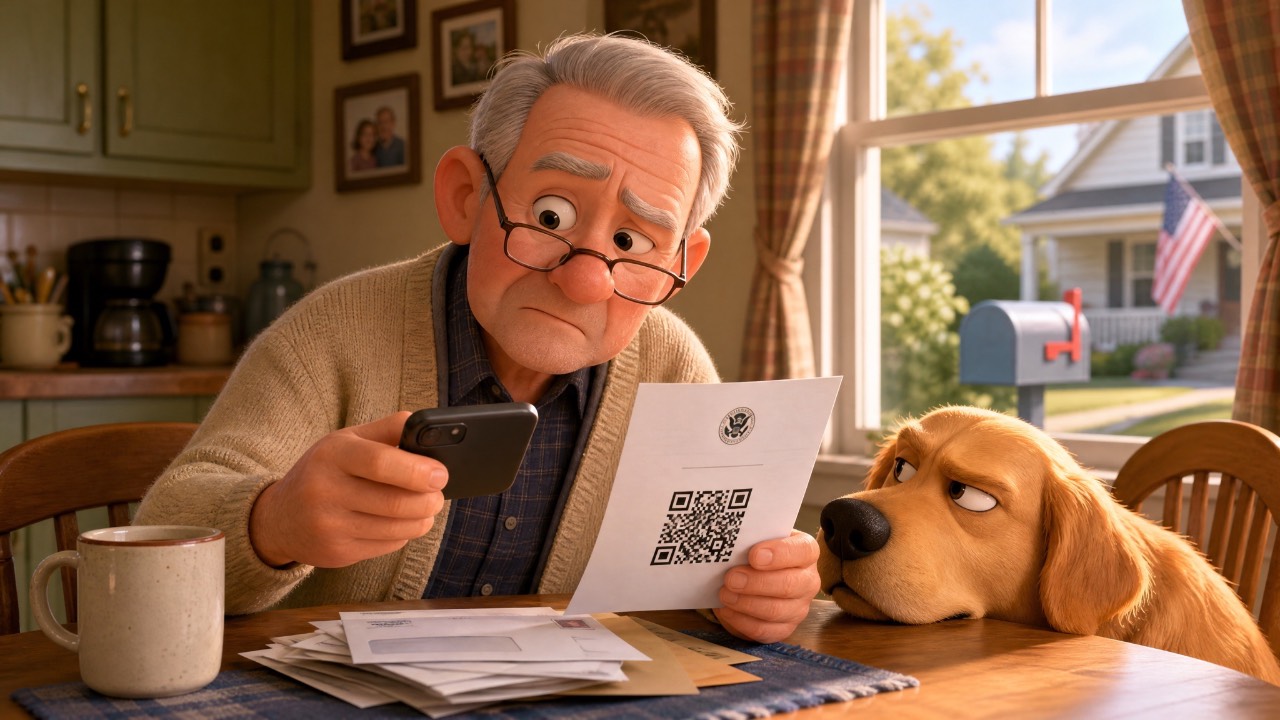
I read an IRS fraud alert this week and had to put my coffee down.
Not because it was a new scam. Because it was an old trick in a new coat.
Crooks are posting paper letters to crypto holders. Proper letters. Treasury branding, a notice number, a deadline and a big black QR code. Scan it and you land on a slick copy of IRS.gov asking about your crypto.
The IRS put it plainly on July 30: it did not send these letters, and the “Digital Asset Compliance Portal” they point to does not exist.
Here is why this one worries me more than the usual email nonsense. It comes through your front door, in an envelope, like a real bill. And that is exactly how the real IRS writes to you.
So let’s take it apart, piece by piece.
📬 The scam that arrives with a stamp
This scam works because it copies the one habit the real IRS has.
The IRS says it starts most contacts through regular mail from the US Postal Service. Not texts. Not calls. Letters.
So we have all been trained, for years, to treat a phone call from the “IRS” as fake and a letter as serious. The crooks noticed.
It is like a burglar who stops climbing through windows and starts ringing the doorbell in a gas company uniform. Same burglar. Better costume.
When was the last time you questioned an envelope before you opened it?
Here is the so what. The letter is not the danger. The QR code is. A real IRS letter will never need you to scan anything to find out what it wants.
|
Why it matters to you If you own any crypto through Coinbase, Robinhood, Kraken or similar, you are the target list. Real IRS mail can be checked by typing IRS.gov into your browser yourself. Never by scanning. |
Why the timing is so sneaky
The crooks picked the one year you half expect crypto mail from the IRS.
For the 2025 tax year, US crypto exchanges had to send a brand new form, the 1099-DA. It is a tax slip that reports what you sold, the same way your bank reports interest. Those forms went out in early 2026. From next year they must also show what you paid for your coins, not only what you sold them for.
So a letter talking about “digital asset compliance” does not sound mad. It sounds like the next piece of paperwork.
It is like a fake parking ticket slipped under your wiper the same week the town changes its parking rules. You would probably pay it. Wouldn’t most of us?
The so what: new rules are real, but they arrive through your exchange and your tax preparer. The IRS does not run a sign-up portal for your crypto. There is nothing to enrol in.
🧾 The scan is step one. The phone call is the robbery.
The fake website does not steal your money. It books you an appointment with the caller who will.
According to Help Net Security’s write-up of research by Coinbase and security firm DarkTower, the fake site asks three things. Which exchange or wallet you use. Roughly how much you hold. And your phone number, “for verification.”
Then the phone rings. A calm, helpful voice from “support” asks for a one-time code, your password or your seed phrase. That is the list of 12 or 24 words that acts as the master key to a crypto wallet. Or they ask you to move your coins to a “safe” wallet. Theirs.
The website behind it was registered through a Hong Kong company days before the letters went out, and hosted in Romania. Not quite Washington.
This is not a small hobby. In 2025, Americans aged 60 and over filed 42,271 crypto complaints with the FBI and reported $4.35 billion in losses (FBI IC3, 2025 report).
|
“The IRS did not send it. The IRS does not operate a Digital Asset Compliance Portal. This is a scam.” IRS Criminal Investigation, July 30, 2026 |
So how do you tell a real letter from a fake one in under a minute? Four checks:
- No QR code needed. If the letter wants you to scan to find out more, bin it.
- Type the address yourself. Go to IRS.gov by hand. Never use a phone number or web link printed on the letter.
- No one gets your seed phrase. Not the IRS, not your exchange, not a nice man called Kevin. Nobody legitimate will ever ask.
- Report it. Send suspicious IRS letters to IRS.gov/submitatip. If you lost money, file at IC3.gov too.
|
Why it matters to you Do the sums on those FBI figures and each crypto complaint from a senior works out at roughly $103,000 lost. A deadline on a letter is designed to rush you. Real tax problems give you time to check, question and appeal. |

📈 Bitcoin had a good week. So did the crooks.
Rising prices make every crypto message feel urgent, and that is when scams land best.
Bitcoin hit $87,265 on Wednesday, September 23. Its highest level in eight months. By Friday morning it sat at $85,200, up 10.4% on the week (Yahoo Finance, September 25).
Keep it in proportion. It is still 25.5% lower than a year ago, and a long way from its October 2025 peak of $126,198. And traders now put a 75.3% chance on the Fed raising interest rates again in October (CME FedWatch via Yahoo Finance, September 24). Higher rates have tended to take the fizz out of rallies like this one.
A rally is like a busy county fair. More people, more cash out, more excitement. And more pickpockets working the crowd. Do you think the fox sends his letters in a quiet month?
The so what: when your balance jumps, you look at it more. You worry about it more. A letter saying your crypto needs “verifying” hits harder when there is more of it to lose. Good news on the chart is the moment to be slowest with the mail.
Where that leaves us
Put it together. A real new tax form. A real IRS habit of writing letters. A rising market. The crooks did not invent any of that. They borrowed it.
And the portal at the centre of it all is about as useful as a chocolate teapot. It exists only to melt your savings.
My prediction: this will not be the last one. Early next year the 1099-DA forms will show what you paid for your coins as well as what you sold them for. That is fresh paperwork, fresh confusion, and I expect a fresh wave of fake letters timed to land with it.
The defence stays boring and it stays free. Type the address yourself. Keep your seed phrase to yourself. Slow down when the letter says hurry.
Have you had one of these letters, or anything like it? Hit reply and tell me. I read every one, and your story might save someone else’s savings.
Until next time,
Andrew
www.CryptoSecretsLab.com
P.S. Do this today, it takes two minutes. Open your browser, type IRS.gov yourself and bookmark it. Then write “Never scan. Never share the 12 words.” on a sticky note and put it wherever you open your post. Next time an official-looking envelope turns up, you will already know the drill.
Get the latest news, tips, and updates!
Enter your info below to get helpful updates about how to make money from crypto.
We hate SPAM. We will never sell your information, for any reason.
