
Why Michael Saylor Sold Bitcoin — And What It Means
Jun 09, 2026
Last week I did a special introductory promotion of my new ACM system for making money every day from crypto. It's had rave reviews and Ive now collected more than 40 videos of students who rave about their results.
If for some reason you missed it, you can still watch the replay of the training here, before the price rise this week.
Now then, onto this week's crypto news. There’s a particular kind of sermon many people have sat through more times than they care to admit.
A man stands on a stage. He’s made a fortune doing one thing, and he’s worked out that the trick to keeping the faithful is to repeat that one thing until it sounds like scripture.
In crypto, the commandment was always the same: never sell. Hold on. The weak hands sell; the worthy hold forever.
I believed a few of those sermons once. It cost me.
So when the loudest preacher of “never sell” was caught quietly selling, I’ll confess to a small, ungenerous flicker of satisfaction. Then I read the fine print — and the story turned out to be far stranger than the headline.
Let me walk you through it.
🎭 The 'high priest' of crypto sold 32 coins
The amount Michael Saylor’s company sold was almost nothing — which is the whole reason it mattered.
Saylor runs a firm called Strategy (you may remember it as MicroStrategy). It’s the largest of a new breed of company — call them crypto hoarders — that exist mainly to buy Bitcoin and sit on it. About 70% of all the Bitcoin held this way sits on Strategy’s books alone.
For years, Saylor’s message never wavered: never sell. Then a regulatory filing — a Form 8-K, the report American companies must lodge when something notable happens — showed the firm had sold 32 Bitcoin in late May, at around $77,135 each.
Set against their pile of 843,706 coins, that’s 0.0038%. A man with a swimming pool noticing a teaspoon has gone missing.
So why did the market lurch at a teaspoon?
Because it was never about the teaspoon. It was about the promise.
The one thing everyone assumed — that this firm would never, ever sell — turned out not to be a law of nature after all. The firm runs on borrowed money, and it owes around $1.5 billion a year to a special class of shareholders. The cash cushion set aside for those payments had quietly shrunk from $1.44 billion to about $871 million after a big debt buyback. Under eight months of runway. Selling those coins was the firm admitting, out loud, that more might follow.
| Why it matters to you When the biggest buyer in the room might turn seller, everyone else reaches for a calculator. That’s how a $2.5 million sale managed to rattle a market worth a thousand times more. |
| “When the biggest believer blinks, everyone in the room recalculates.” |
🌧 Why everything feels heavy right now
Bitcoin didn’t fall in a vacuum — it fell into a storm that had been building for months.
The coin sits near $62,000 as I write, down roughly 24% from its May high. And the weather outside is grim.
America’s jobs report came in hot: 172,000 new jobs in May, more than double the 80,000 forecasters expected. Splendid news if you’re looking for work. Less splendid if you were hoping for cheaper money, because a strong jobs market hands the Federal Reserve — America’s central bank, the body that sets interest rates — every excuse to keep those rates high.
Inflation isn’t helping. The Fed’s favourite measure (a thing called core PCE, which strips out wobbly food and fuel prices to show the underlying trend) hit 3.3% in April, and one forecast sees it climbing to 4.5% by year-end. The snag is that the Fed is being asked to fix a supply problem with demand tools — rather like curing a leaky roof by turning down the thermostat. Higher rates can’t put more lorries on the road or unblock a jammed shipping lane.
Then there’s Japan. Its central bank looks almost certain to raise rates on 16 June. For years, investors borrowed cheap Japanese money and parked it in American assets; when Japan raises rates, some of that money sails home — which tends to nudge American borrowing costs up and risky things like crypto down.
So where’s the floor?
There’s a band between $58,000 and $60,000 worth watching — roughly what long-term holders paid for their coins. Hold it, and the bigger picture stays intact. Lose it, and the conversation changes.
| Why it matters to you You don’t need to forecast any of this. You need to know the weather’s rough — and that rough weather is precisely when steady hands beat brave ones. |
⚖ One quiet vote in Washington
While the headlines screamed about selling, lawmakers took a quiet step toward making crypto boring — in the best possible way.
A bill called the CLARITY Act (full name: the Digital Asset Market Clarity Act) cleared an important Senate committee on a cross-party 15–9 vote. Dull-sounding, I know. Stay with me.
The bill would settle a question that has dogged crypto for a decade: in the eyes of the law, what is a digital coin? A security, like a share in a company? Or a commodity, like gold? And who gets to police it? Right now nobody quite agrees — and that fog is what keeps big, cautious money on the sidelines.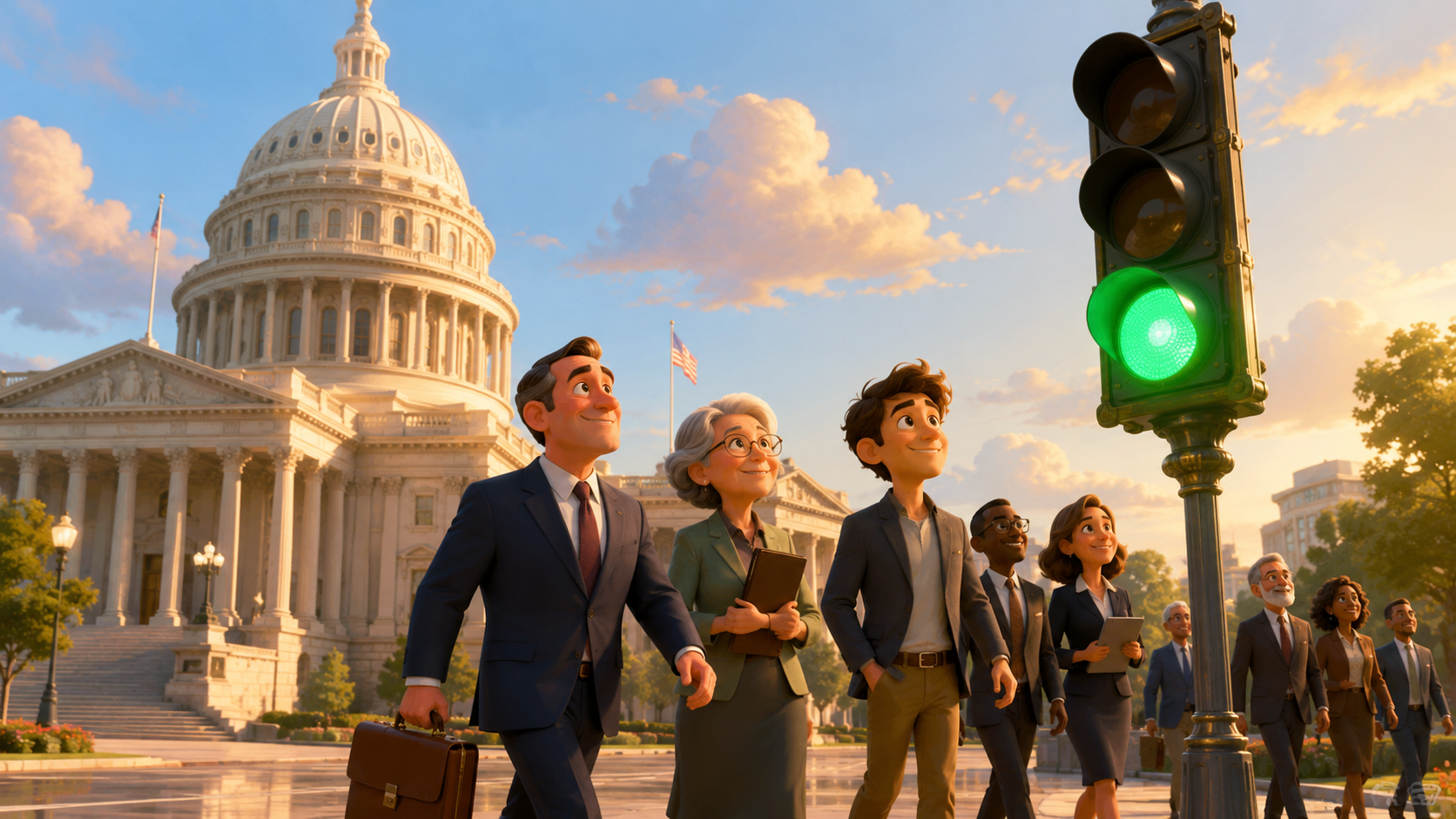
Three things to watch from here:
| 1. | It reaches a full Senate vote — which would cheer the market and tempt bigger players in. |
| 2. | It picks up amendments — slower, but it could settle worries about stablecoins and consumer protection. |
| 3. | It stalls — Congress has a packed diary and breaks up in August, so this could slip to July or later. |
Senator Cynthia Lummis says the bill is “at the 5-yard line” — American football for ‘nearly there’. Could a piece of dry paperwork matter more than all of Saylor’s drama? Quite possibly.
| Why it matters to you Big institutions hate uncertainty more than they hate risk. Clear rules are the green light they’ve been waiting for — the sort of slow, unglamorous progress that builds markets that last. |
So where does that leave us?
A market that’s taken a knock. A backdrop that’s genuinely tricky. And one piece of good news quietly making its way through Washington.
None of this is a reason to panic. None of it is a reason to celebrate. It’s a reason to pay attention.
We British have a phrase for moments like this: keep calm and carry on. It survived a war; it’ll survive a 24% dip. The people who do well from here won’t be the loudest or the bravest. They’ll be the ones who kept their heads while a very famous man lost his nerve over a teaspoon.
My hunch? The next few weeks belong to the patient. We’ll see whether $60,000 holds, and whether Washington finds its floor time before the summer.
Get the latest news, tips, and updates!
Enter your info below to get helpful updates about how to make money from crypto.
We hate SPAM. We will never sell your information, for any reason.
