
How To Invest In Humanoid Robotics: BOT & DEUS Explained
Jun 02, 2026
My friend's grandfather served his entire working life as a labourer in a Yorkshire mill. He used to tell me that the word for someone who did backbreaking, repetitive work in medieval Europe was “robota.” A peasant doing forced labour for their lord. That’s where the word “robot” comes from.
I think about that a lot these days. Because the robots are coming. Properly coming, this time. Boston Dynamics, Nvidia, Figure AI, 1X — these aren’t science fiction names anymore. They’re companies with billions of pounds in funding, building machines that walk, lift, sort, and increasingly think for themselves.
Morgan Stanley reckons humanoid robots will be a $5 trillion-a-year business by 2050. Goldman Sachs is more modest at $38 billion by 2035. Either way, it’s an enormous wave heading toward us.
So how does a regular person get a piece of that? Until recently, the answer was: you don’t. The good investments were locked behind doors only the wealthy could open. That’s starting to change, and two products launched recently make the change concrete.
Let’s talk about both. But first, the macro stuff that’s been making everyone sweat.
The Inflation Number That Spoiled Everyone’s Week 🔥
The Fed’s favorite inflation gauge came in hotter than expected. That changes the maths for every investment.
Quick context. The Federal Reserve (the US central bank) watches a specific inflation number called core PCE. Think of it as their thermometer. When it runs hot, they raise interest rates to cool things down. When it runs cold, they cut rates to warm things up.
This week the thermometer read 3.3% for April. The headline version came in at 3.8%, the highest since May 2023. That’s the economic equivalent of finding out your tea is too hot just as you were about to drink it.
Here’s why this matters for Bitcoin. When inflation is rising, the Fed can’t cut interest rates without making it worse. And government bonds (the safest, most boring investment in the world) start paying decent returns to compensate investors for taking on inflation risk.
The US 30-year government bond has been paying interest at levels not seen since 2007. Imagine you’re at the pub, and a mate offers you a guaranteed return with zero risk. You’d probably take that over a punt on something volatile. That’s what high bond returns do to the appetite for Bitcoin.
The result: Bitcoin fell from $82,000 to below $73,000 over the past few weeks. The investment funds that hold Bitcoin (called spot Bitcoin ETFs, which let regular folks buy Bitcoin through their normal stockbroker) have now seen nine straight days of investors pulling their money out. Roughly $2.8 billion has walked out the door in three weeks.
This isn’t panicked retail. It’s big professional money calmly deciding the safer option pays well enough right now.
The hopeful counter-argument: researchers track something called the “realised cap” for Bitcoin, which is the average price everyone currently holding Bitcoin paid for their coins. That number has stopped falling. Historically, when this measure stabilises after a big drop, it has tended to mark the bottom. This pattern doesn’t look like the previous bear markets of 2014, 2018, or 2022, which is genuinely good news.
So one set of indicators says “more pain coming.” Another says “you may already be at the floor.” The boring bond market gets to decide which.
A Quiet Regulatory Win 📜
While everyone watched Bitcoin’s price drama, something genuinely significant happened in Washington that nobody’s talking about.
The CFTC (one of America’s main financial regulators) just approved the first regulated US platform to offer a type of crypto trading called perpetual futures. Until now, this kind of trading has been available only through offshore platforms outside US jurisdiction. American regulators have officially said: come home, we’ll let you do this here.
Why does this matter? It’s the regulatory equivalent of building a proper motorway where everyone has been using a bumpy farm track. The professional money that’s been sitting on the sidelines because they don’t want regulatory risk now has a legitimate route in.
The CEO of Intercontinental Exchange (the company that owns the New York Stock Exchange) made an even more startling comment. He publicly said that Hyperliquid, a relatively young crypto trading platform, is “bigger than Nasdaq” by trading volume. He also disclosed his team has met with the founders.
That’s the Chairman of one of the world’s largest financial institutions taking a much smaller crypto-native competitor seriously enough to fly out and meet them. Three years ago that conversation would have been unthinkable.
Why it matters to you: The near-term mood is gloomy and that may continue for a few weeks yet. But the long-term picture for crypto keeps improving in real, durable ways. The biggest opportunities are usually built during the worst-feeling moments. Don’t confuse the weather for the climate.
The Robot Goldrush Has Already Started 🤖
Behind closed doors, the wealthy are pouring billions into humanoid robotics companies. Most regular people have no idea this is happening.
Pop quiz: what do Nvidia, Intel, Brookfield, Salesforce, Google, Mercedes-Benz and SoftBank have in common?
They’ve all been quietly piling money into humanoid robot companies over the past 12 months.
Here’s a sample of what’s been happening, in pounds and pence:
- Figure AI raised over $1 billion in funding at a $39 billion valuation last September. That’s roughly 15 times what the company was worth just eight months earlier. Nvidia, Intel Capital, Salesforce and others all wrote cheques.
- Apptronik raised $935 million at a $5.3 billion valuation, with Google and Mercedes-Benz in the round.
- Skild AI tripled in value to over $14 billion in just seven months, led by SoftBank.
These are young companies. Some of them barely have working products yet. Yet professional investors are willing to pay valuations that would make a Premier League football club blush.
Why? Because Jensen Huang, the founder of Nvidia (the company that makes the chips powering most of the world’s AI) said at a tech conference last year that “the ChatGPT moment for general robotics is right around the corner.” When the man whose company prints money from selling shovels in the AI goldrush tells you the robotics goldrush is next, you tend to listen.
Here’s the catch though. Almost every interesting robotics company is private. That means you can’t buy shares through your regular broker. To invest, you need to be what regulators call an “accredited investor” — in America, that means $200,000 in annual income or a million in net worth not including your house. In other words, the people who least need the gains are the only ones allowed to make them.
The door has been bolted from the inside. Until now.
Two New Ways To Buy The Robots 🔑
Two products have just launched that let regular investors get exposure to private robotics companies. One is regulated and traditional. One is crypto-native and experimental.
The first is called Robostrategy. It listed on the Nasdaq this month with the ticker BOT. Think of it as a basket. You buy one share, and that share owns small slices of private robotics companies like Figure AI, Apptronik, Dyna Robotics and Standard Bots.
The clever part is how it grows. When BOT shares trade for more than the value of the robotics holdings inside, the fund issues new shares and uses the cash to buy more robotics company stakes. It’s a flywheel: rising share price funds more acquisitions, which makes the basket more valuable, which lifts the share price again. The same trick Strategy used with Bitcoin, applied to robots.
It’s run by Andrew Kang, who has a real track record from his days at a firm called Mechanism Capital. It has a $2 billion equity facility behind it. It’s a properly regulated security.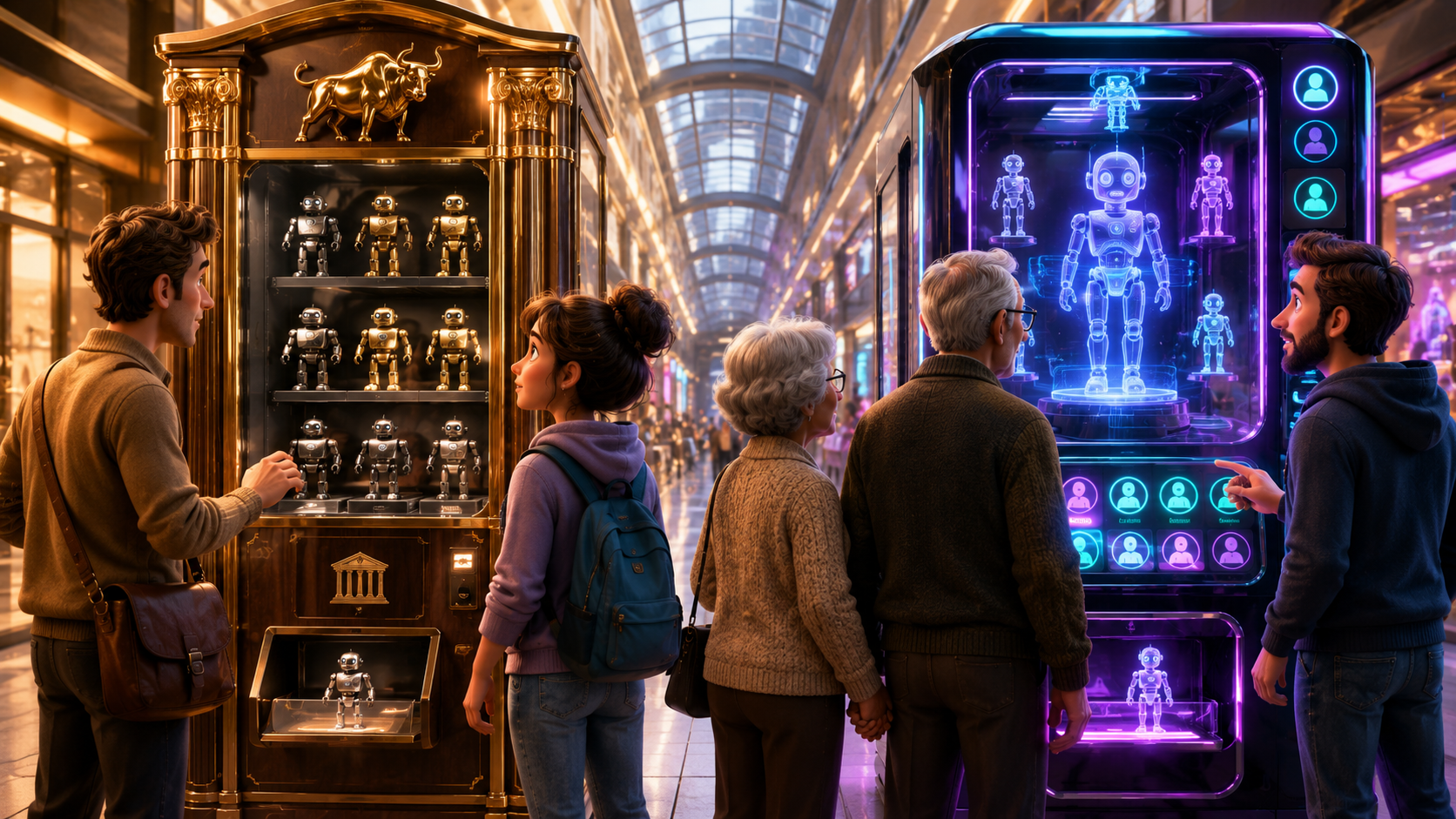
The second is called XMAQUINA. This is the experimental crypto version. It’s structured as a DAO — that’s short for “decentralised autonomous organisation,” which in plain English means it’s a fund collectively owned and directed by the people holding its token (called DEUS).
XMAQUINA raised over $10 million from a mix of crypto and traditional investors. It used most of that to buy small equity stakes in real robotics companies. Each stake is held through what’s called a special purpose vehicle, which is a legal wrapper that lets the DAO own actual shares in private companies.
The token holders vote on which robotics companies to invest in next. So you’re not just buying exposure, you’re shaping the direction of the fund itself.
Here’s where it gets interesting and slightly worrying. XMAQUINA officially holds about $30 million in total value. But $19 million of that is its own DEUS token. After the FTX collapse a couple of years ago, where a company’s entire treasury was just its own token (which then became worthless), seasoned investors learned to discount that kind of holding to zero. Strip the DEUS out and the real value is closer to $10 million.
So which one is the better bet? My honest take, BOT is the safer, sturdier option. Regulated, properly capitalised, run by a named CEO with skin in the game. DEUS is more accessible to anyone outside the US stock market, more community-driven, and currently pays a 39% yield to people who stake their tokens. That’s a higher reward, but with substantially more risk.
Neither is a sure thing. Both are bets that humanoid robots become the next trillion-dollar industry. Place those bets accordingly.
Where This Leaves Us
Bitcoin’s wobble is making everyone nervous. The bond market is being a misery. The Fed is stuck. None of that is comfortable.
And at the same time, the most important technological shift since smartphones is happening in plain sight, and for the first time in decades, regular people can actually participate in it without needing a million in the bank.
It’s a bit like the railway boom in Victorian Britain. Most people watched the trains thunder past and thought “impressive.” A small number realised the entire economy was about to be rebuilt around them and got in early. The ones who got in early changed their family’s lives for generations.
My prediction? In ten years time, humanoid robots will be as common as smartphones are today. The people who bought the picks and shovels of that boom will look ridiculously prescient. The ones who stood by saying “robots are just science fiction” will be the same ones who said the internet was a passing fad in 1995.
Get the latest news, tips, and updates!
Enter your info below to get helpful updates about how to make money from crypto.
We hate SPAM. We will never sell your information, for any reason.
