
Bitcoin took three punches. It's still standing.
Sep 23, 2026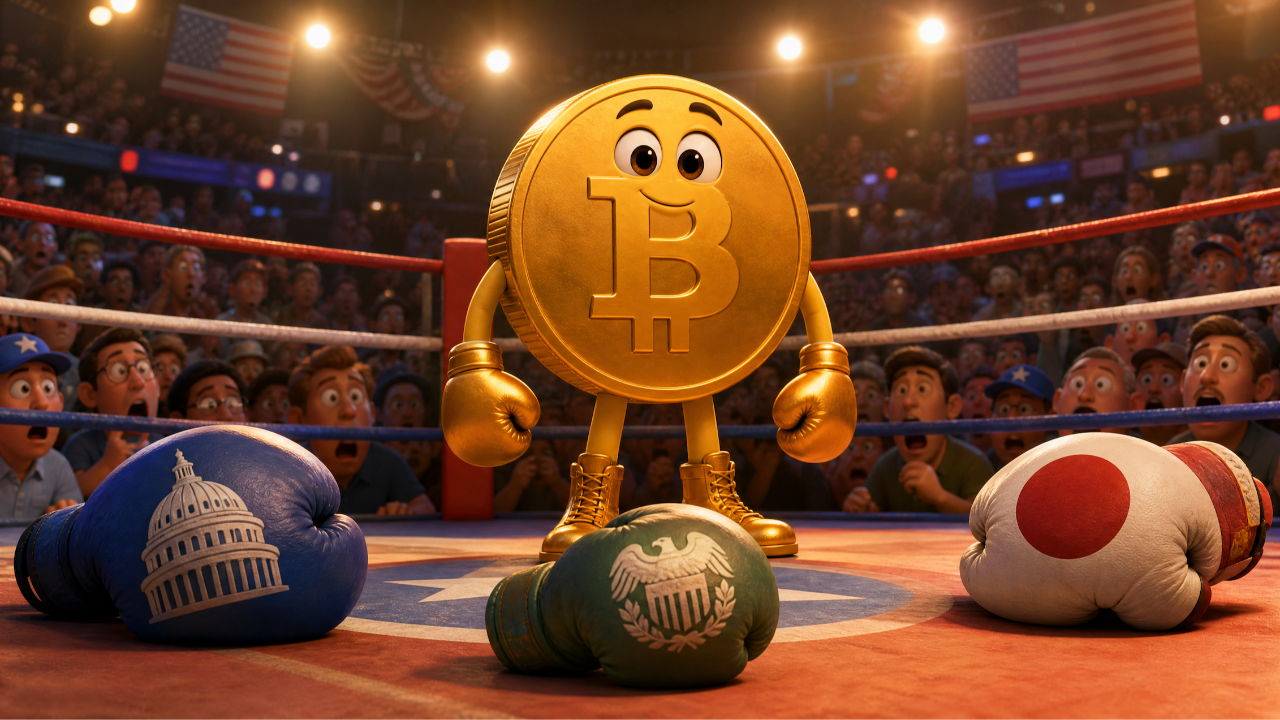
Last week had everything a nervous crypto holder dreads.
A bill the industry spent years and a fortune on died on the Senate floor. The Fed raised rates for the first time since 2023. Then the Bank of Japan raised its rate to the highest level since 1995. Three blows in four days.
I sat down on Tuesday expecting to write you a “keep calm” email. Instead, Bitcoin opened this morning at $86,195. It is up 14% on the week.
So this issue is about a question I kept turning over while watching the price chart do the opposite of what the headlines said it should. When bad news arrives and the price shrugs, what does that tell you? Quite a lot, as it happens. Let’s take the three punches one at a time.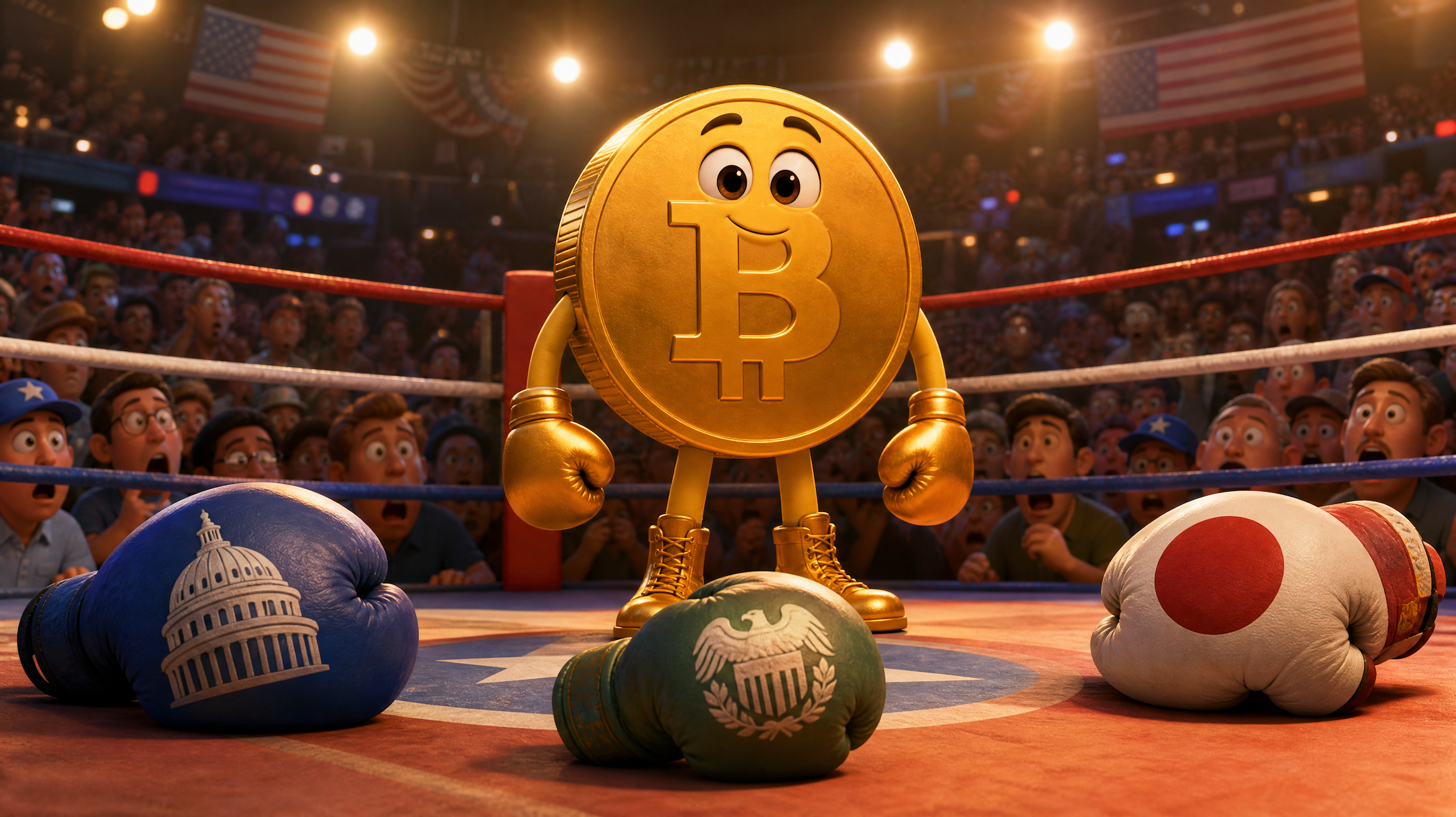
📈 Three punches, no knockdown
When a market absorbs bad news it already expected, the news was never the risk. The surprise was.
Here is what landed between Tuesday and Friday:
- Tuesday, September 15. The Clarity Act, the big crypto market rulebook, failed its Senate procedural vote 49 to 50. It needed 60.
- Wednesday, September 16. The Fed raised rates a quarter point to 3.75% to 4%. The vote was 12 to 0. First hike in over three years.
- Friday, September 18. The Bank of Japan raised its rate to 1.25%, its highest since 1995. The vote was 7 to 2.
Bitcoin dipped to around $75,600 in the hours after the Senate vote. Then it climbed. As of 7:26am Eastern this morning it sat at $85,600. Up 14% on the week and 11.8% on the month, though still 23.6% below where it was a year ago.
Think of it like a dentist appointment. The dread is worse than the drilling. You spend a fortnight worrying, then the thing happens, and you walk out thinking “that was it?” Markets do the same. The Fed hike was expected by nearly everyone. The Clarity failure had been telegraphed for days. The Bank of Japan had been flagging its move for weeks. None of it was news by the time it happened. The price had already paid for the appointment.
One caution before anyone gets carried away. Fed Chair Warsh was not soft at his press conference. His words: “Inflation is too high and has been for too long.” Sixteen of the nineteen Fed officials expect at least one more hike before the year is out. Rates going up is not usually kind to speculative assets, and this time the market chose to look past it. Will it keep doing that if the next inflation reading comes in hot?
The practical bit: the next thing that matters is the PCE inflation report due later this month. That is the Fed’s favourite inflation gauge. Cool number, the November hike fades. Hot number, it comes back. Put the release date in your diary and do nothing dramatic before it.
|
Why it matters to you If you sold on the Senate headline last Tuesday, you sold near $75,600 and watched the price climb $10,000 in a week. Headlines are not signals. Expected bad news is already in the price by the time you read about it. |
😥 No Clarity in Washington
The bill did not die over crypto. It died over who gets to profit from crypto while writing the rules.
A quick refresher. The Digital Asset Market Clarity Act is the bill meant to settle which regulator watches which coin. Roughly, the SEC handles things that look like shares and the CFTC handles things that look like commodities. The House passed it 294 to 134 last year, with more than 70 Democrats voting yes. Most people expected the Senate to follow.
It did not. Every Democrat voted no. So did three Republicans on the merits: Susan Collins, Josh Hawley and Jerry Moran. A fourth, Thom Tillis, switched his vote to no at the last second. That was tactical. Under Senate rules only someone on the winning side can file a “motion to reconsider,” and that motion keeps the bill alive without starting from scratch. Tillis took one for the team.
So what sank it? Ethics. Democrats wanted binding language stopping the president and senior officials from profiting from crypto while writing crypto law. That demand hardened after a June financial disclosure showed President Trump earned $1.4 billion from crypto ventures in 2025. Republicans offered new language over the weekend before the vote. Critics said the divestment rules had a hole big enough to walk through, and Democrats did not want enforcement handed to a Justice Department run by the president’s former personal lawyer.
The banks played a part too. Both the GENIUS Act and Clarity ban paying interest on idle stablecoins (digital dollars). But Clarity allowed “activity based” rewards, meaning perks tied to spending or loyalty. The American Bankers Association argued this was interest wearing a false moustache, and that it would pull deposits out of community banks. Hawley and Moran said that was why they voted no.
Then there is the calendar. The midterms are on November 3, seven weeks away. Handing the White House a signature win while campaigning against the president’s crypto earnings? Not a trade many Democrats were going to make.
It is like a house sale that collapses the day before exchange. The survey was fine. The mortgage was approved. Then someone found a clause in the contract about who keeps the garden shed, and the whole thing fell over.
Is it dead? Not quite. The GENIUS Act failed its first procedural vote 48 to 49 in May 2025 and cleared a second one 66 to 32 eleven days later. Tillis’s motion means Majority Leader John Thune can bring Clarity back. Seven Democratic negotiators, including Kirsten Gillibrand and Mark Warner, put out a statement saying they still want it passed. The catch is time. The Senate breaks in early October, the post-election session is stuffed with spending bills, and if nothing passes before the new Congress sits in January, the bill starts over. Polymarket has Clarity becoming law this year at about 8%.
Note who took the hit. Bitcoin dipped 3% and recovered. Coinbase fell about 8% on the day. Circle fell about 10%. The bill barely changes Bitcoin’s legal position. It changes everything for companies that need US permission to operate. If you hold crypto stocks rather than crypto, this vote was your story, not Bitcoin’s.
🏛️ The SEC picks up the pieces
With Congress stuck, the regulators are writing their own rules. Useful, but built on sand.
Who would have guessed, a few years ago, that crypto would be looking to the SEC for comfort? Yet here we are. The day after the vote, SEC Chair Paul Atkins posted this:
|
“With or without legislation, we will act decisively within the SEC’s statutory authority to deliver certainty for American investors.” Paul Atkins, SEC Chair, September 16, 2026 |
About 24 hours later the SEC published its “Innovation Exemption.” In plain English: it lets approved venues trade tokenised versions of US stocks on public blockchains without registering as a stock exchange. A tokenised stock is an ordinary share, say Apple, wrapped in a digital token so it can move on a blockchain like a coin does.
The guardrails are tight. A venue starts at 75 stocks and a sliver of daily volume (0.25%), rising to 250 stocks and 2.5% at the upper tier. Every token must carry the same rights as the real share. If a company objects to being tokenised, it gets written notice and 30 days to say so. If trading halts on the main exchange, it halts on the token venue too. The exemption runs five years.
Think of it as a learner driver with L plates. You are allowed on the road. You are not allowed on the motorway yet.
The CFTC chair, Michael Selig, said his agency is “locked in and ready to ship” its own crypto rules. One problem. He is the only sitting commissioner on a board built for five. Ready to ship, yes. Short of crew, also yes.
The catch. Agency rules are not laws. A future SEC can repeal them. A court can strike them down, and since the Supreme Court’s Loper Bright ruling in 2024, courts no longer defer to an agency’s own reading of a vague statute. Atkins himself has admitted the SEC’s crypto rules will not last without a law underneath them. Would you build a house on a five-year lease with a landlord who can change his mind?
So what: if you see “tokenised stocks now legal in the US” headlines, read them as “legal for now, on a trial basis, in small amounts.” Good news. Not permanent news.
The Japan wrinkle
The rate hike nobody in crypto was talking about is the one worth watching.
The Bank of Japan took its rate to 1.25% on Friday, the highest since 1995. Strange thing: the yen weakened after the decision. That is the opposite of what a rate hike normally does. The reason is the 7 to 2 vote. Two members wanted to hold, so traders read the hike as hesitant rather than the start of a march.
Why should a Bitcoin holder care about Tokyo? Two words: carry trade. For years, big investors borrowed yen at near-zero rates and put the money into riskier assets elsewhere, including crypto. When Japanese rates rise and the yen strengthens, that borrowed money gets expensive, and investors sell risk assets to pay it back. That is what triggered the global sell-off in August 2024.
It is like a bar tab. Cheap drinks all night, then the landlord announces the prices have gone up and everyone reaches for their coats at once.
This time the yen fell, so the tab has not been called in. But the Fed and the Bank of Japan are now both raising rates, and the gap between them will narrow if that continues. Watch the yen against the dollar. A sharp strengthening in the coming weeks is your early warning that volatility is coming.
|
Why it matters to you The August 2024 sell-off knocked Bitcoin hard in a matter of days and had nothing to do with crypto news. The same mechanism is loaded again. It has not fired. If you only follow crypto headlines, you will not see it coming. The yen chart will. |
Where that leaves us
Three blows, one week, and Bitcoin is higher than it was before any of them landed. That is not luck. It is what happens when a market has spent months bracing for news and then gets exactly the news it braced for.
It reminds me of the British summer. Everyone spends June complaining it will rain at the barbecue. Then it rains at the barbecue, and everyone carries on eating under the gazebo, because they packed for it.
My prediction: Bitcoin holds above $80,000 through the end of the month, provided the PCE report does not come in hot. If it does, expect a sharp but short pullback rather than a change of trend. The risk that changes the picture is not Washington. It is Tokyo.
Get the latest news, tips, and updates!
Enter your info below to get helpful updates about how to make money from crypto.
We hate SPAM. We will never sell your information, for any reason.
