
Bitcoin Passed the Inflation Test. Now It Needs the Fed.
Oct 20, 2026
Last Wednesday at 8:30 in the morning, the government published one number. By lunchtime, Bitcoin had slipped, chip stocks were bleeding, and traders had doubled their bets on a Fed rate hike.
The number was 3.7%. That’s how much prices rose in the year to September. Economists had expected 3.6%.
One tenth of a percentage point. That’s the gap between a quiet Wednesday and a stampede.
I read the coverage that afternoon fully expecting the floor to give way. It didn’t. Five days later, Bitcoin is trading around $82,500.
So today I’ll show you three things. Where Bitcoin’s floor sits. Where its ceiling sits. And why one meeting on October 28 decides which of the two gets tested next.
Then we’ll look at why Wall Street is trying to sell computer chips like barrels of oil. (It’s going about as smoothly as you’d guess.)
🌡️ One tenth of a point, one wild morning
A tiny inflation miss doubled the odds of a rate hike in a single morning.
The September inflation report landed on October 14. Prices were up 3.7% on the year, a jump from 3.4% in August. Gasoline did most of the damage. It rose 9.1% and accounted for about half the increase.
“Core” inflation, which strips out the jumpy stuff like food and fuel, came in at 2.6%. That was up from 2.4% the month before.
Traders panicked. CME’s FedWatch tool turns futures prices into odds of what the Fed will do. It had an October rate hike at roughly 20% before the report. By midday it was 41.5%.
Then came Friday. Fed chair Kevin Warsh said the economy had performed largely as expected since September’s hike. The odds of another hike in October dropped to about 15%.
It was like a smoke alarm going off over burnt toast. Everyone ran for the door. Then they stopped on the lawn and sniffed the air.
One snag. Warsh has a habit of not telling markets what he plans to do before the vote. So is it burnt toast, or is the kitchen on fire?
Nobody knows yet. Which is why the October 28 decision matters far more than last Wednesday’s panic.
|
WHY IT MATTERS TO YOU When rates go up, cash and bonds pay you more for doing nothing. That makes riskier things like Bitcoin less tempting, so the price flinches. Expect a twitch around every inflation report and Fed meeting from now until year-end. Plan for it, so you don’t react to it. |
So where does Bitcoin land if the Fed does surprise everyone? The blockchain itself gives a surprisingly clear answer.
🧱 Stuck between the floor and the ceiling
Bitcoin is standing on a solid floor, with a low ceiling right above its head.
Every Bitcoin transaction is public. So analysts can work out roughly what different groups of buyers paid. Those prices matter, because people behave differently when they’re winning, losing, or breaking even.
The research firm Glassnode published its weekly report on October 14. Here are the numbers that count:
- $81,500. The average price paid by buyers of US spot Bitcoin ETFs (funds that hold real Bitcoin and trade like shares). Bitcoin dipped below it on October 8 and October 13. Both days, it closed back above.
- $80,000. The biggest wall of buy orders on Binance, the world’s largest crypto exchange.
- $78,000. Glassnode’s “True Market Mean,” its estimate of what active investors paid on average.
- $88,000. What people who bought six to twelve months ago paid. Bitcoin reached this level in January, then fell by more than a third.
The floor looks sturdy. Long-term holders who sell at a loss usually do it in despair. That kind of selling peaked on August 12 and has since fallen about 85%.
The ceiling is the problem. Picture a lift stuck between two floors. The cables are fine and it won’t drop. But it won’t go up either, until someone presses the right button.
At $88,000, a big crowd of recent buyers finally gets their money back. If you’d spent most of a year underwater, what would you do the moment you broke even?
Exactly. Sell, and swear off it for a while.
|
“Bitcoin passed the strength test this week. It failed the momentum test.” |
So what pushes it through? New money. US spot Bitcoin ETFs took in nearly $3 billion between September 21 and October 6. Since October 7, they’ve seen about $760 million flow out. When that number turns positive again, the lift starts moving.
And there’s a second force pressing on that lift button. It lives in Silicon Valley, and it owes a lot of money.
Why chip stocks now move your Bitcoin
The AI boom runs on borrowed money, and borrowed money hates inflation.
On inflation day, chip stocks took a beating. Nvidia fell about 3%. AMD fell about 5.7%.
CoreWeave got it far worse. It buys Nvidia chips and rents them out to AI companies. Its shares dropped 15.5% to $65.78. The next day, one of its bonds briefly yielded more than 16%. That’s the price lenders demand when they start worrying about getting paid back.
Why so jumpy? Debt. The Bank of England’s financial stability committee met on September 25. Its record cites Morgan Stanley estimates that around $450 billion of AI-related debt was issued worldwide by early September. That’s more than double the total for all of 2025.
Morgan Stanley also expects about $700 billion of data centre spending between 2026 and 2028 to be funded by private credit. (That’s loans from investment funds rather than banks.)
Think of a builder who bought every brick on a credit card. Lovely while the rate is low. Rather awkward when the statement arrives with a bigger number on it.
Many of those loans are backed by the chips themselves, or by the rent they earn. So what happens to the loan if the chip loses value faster than anyone planned?
This is where your Bitcoin comes in. When big investors get nervous, they tend to dump their riskiest holdings together. This year, that bundle has often held AI stocks and Bitcoin side by side.
|
WHY IT MATTERS TO YOU If you own an S&P 500 index fund and some Bitcoin, you may feel spread out. But a rate scare can hit both on the same afternoon, as it did last Wednesday. Keep an eye on CoreWeave and the chip stocks. When they wobble on debt fears, crypto often wobbles with them. |
Lenders who are this exposed want a way to protect themselves. Which is how we end up with one of the stranger ideas of the year.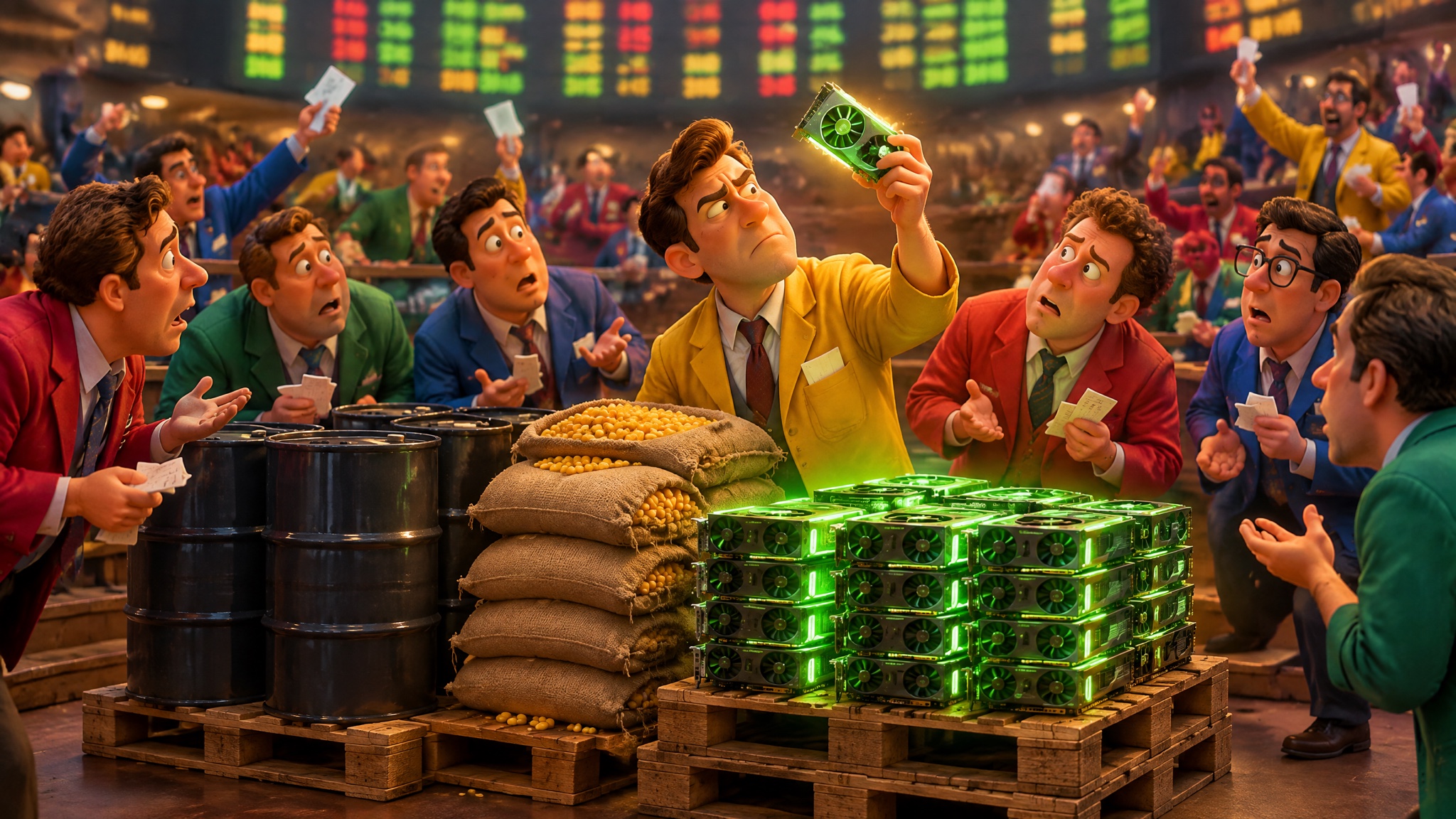
💻 Can you sell a computer chip like a barrel of oil?
Wall Street wants to trade computing power like a commodity, but the regulator isn’t sold yet.
A futures contract lets you lock in a price today for something you’ll buy or sell later. Farmers have done it with corn for over a century.
Now apply that to AI chips. A company that rents out Nvidia H100 chips worries rents will fall while its loan payments stay the same. It sells futures to lock in today’s rate. An AI lab worried about rising costs buys them. Each side sleeps a bit better.
CME, the giant Chicago exchange, has designed contracts that track Silicon Data’s rental price indexes for Nvidia’s H100 and B200 chips. Each contract covers 730 GPU-hours, roughly one chip for a month. Nobody delivers a chip. You settle the difference in cash.
They were meant to launch on October 5. The CFTC, which regulates US futures, extended its review by 45 days to November 9. Its worry: chip rental prices are mostly set in private deals, so a handful of big players could push an index around.
It has a point. A barrel of oil is a barrel of oil. An hour on a chip is more like a hotel room. Same bed, wildly different price in Manhattan and in Omaha.
Silicon Data’s own March figures show it. An H100 hour from smaller providers cost about $2.43 to $2.63. From the big cloud giants, about $7.43 to $7.52. How do you protect yourself against a price that depends on which building you’re in?
Nobody is giving up. ICE, which owns the New York Stock Exchange, plans futures based on an index from a startup called Ornn. Nodal Exchange, which holds more than half of all open US electricity futures, teamed up with Compute Desk in September. And a startup called LiquidCompute raised a $15 million seed round and has applied to the CFTC to run its own exchange.
Crypto got there first, for what it’s worth. Injective and Squaretower launched an onchain H100 rental market in August 2025. It has traded a little over $20 million in total since. A similar market on Hyperliquid shows no trading volume on public trackers. Tumbleweed, in other words.
The so-what: nothing to buy here yet. But watch November 9. If the CFTC approves CME’s contracts, the AI buildout gets a shock absorber. Fewer forced sellers in AI means fewer nasty days for crypto too.
Put it all together and Bitcoin spent the week like a Brit in a post office queue. Shuffling. Sighing. Refusing to leave.
The floor between $78,000 and $81,500 held through a real scare. The ceiling at $88,000 hasn’t moved. And the thing most likely to break the stalemate is a single sentence from Kevin Warsh on October 28.
Behind all of it sits a mountain of AI debt that gets more expensive every time inflation runs hot. Bitcoin is sharing a lift with it, whether it likes it or not.
My guess: the Fed holds in October, and Bitcoin gets another run at $88,000 before Thanksgiving. Whether it breaks through depends on ETF buyers coming back.
Get the latest news, tips, and updates!
Enter your info below to get helpful updates about how to make money from crypto.
We hate SPAM. We will never sell your information, for any reason.
