
Ethereum just mass-dropped its 2029 plan. Here's what it means for your ETH.
Feb 28, 2026
|
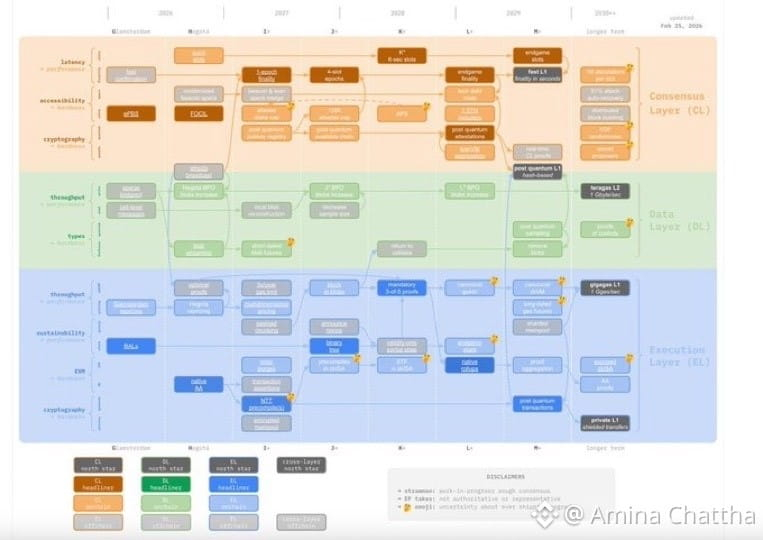
Hi Andy, Right then. Ethereum's new roadmap just landed, and—in absolutely classic Ethereum fashion—it reads like someone fed a technical whitepaper through a blender, stapled it back together, and called it “a plan.” Seriously. If you've ever tried to read one of Vitalik's diagrams, you know exactly what I'm talking about. The man is brilliant. But the communication style is... let's call it “acquired taste.” Here's the 'strawmap' roadmap as they're calling it... Ahem... Spoiler: it's really, really good. 1. Your Transactions Are About to Get Stupidly FastLet's start with something called “finality.” Don't let the word scare you—it just means the point at which the network says, “Yep, that transaction is done. Permanent. No take-backs.” Right now? That takes about 16 minutes. Sixteen. Minutes. In an era where I can order a coffee, pay contactless, and have the barista judging my order in under 30 seconds—Ethereum needs a quarter of an hour to be really, properly sure a transaction went through. The new plan introduces something called the “Minimmit” consensus mechanism (and yes, that's its actual name—the crypto world remains undefeated at naming things). Minimmit replaces the current multi-round voting system with a single round. One and done. The target? Eight seconds to finality. Down from 16 minutes. On top of that, block times—the speed at which new blocks are produced—would step down from 12 seconds to 8, then 6, then 4, and potentially all the way to 2 seconds. That's not a minor tweak. That's a complete overhaul of the engine while the car is still moving. Why it matters to you: Faster finality means faster confirmations, less waiting, less uncertainty, and a much smoother experience when you're actually using ETH in the real world. Bridges, DeFi, payments—everything gets better. 2. From Trickle to Firehose: The Throughput UpgradeHere's the current problem in plain English: Ethereum's main chain (Layer 1) can handle about 15–30 transactions per second. That sounds like a lot until you realise Visa processes around 65,000 TPS on a busy day. The roadmap's target? 10,000 TPS on Layer 1. And 10 million TPS across all Layer 2s combined. Read that again. Ten. Million. Transactions. Per. Second. How? By massively increasing the “gas limit.” Gas is basically the fuel the network burns to process your transactions. Right now there's a fairly tight cap on how much gas can be burned per block. The plan is to blow that cap wide open—by orders of magnitude—across both L1 and L2. Why it matters to you: This is the scalability play. If Ethereum wants to be the backbone of a global financial system (and it does), it needs to handle global-scale traffic. This roadmap is the engineering plan to get there. 3. Quantum Computing: The Threat Nobody Wants to Talk AboutMichael Saylor was recently out there waving away quantum threats to Bitcoin—claiming they're “a decade-plus away” and nothing to worry about. And look, he might be right about the timeline. But here's the problem: if quantum computing eventually can crack the encryption your wallet relies on, then every old, un-updated wallet on the network becomes a sitting duck. It doesn't matter if it's 5 years away or 15—if the plan is “we'll deal with it when it happens,” that's not a plan. That's a prayer. Ethereum's taking the opposite approach. They're treating quantum as a real engineering problem with an actual target fork to fix it. The solution? Switching to hash-based cryptographic signatures—which don't rely on the mathematical assumptions that quantum computers are expected to break. In other words: Ethereum isn't waiting for the house to catch fire before buying a fire extinguisher. Why it matters to you: If you're holding ETH long-term (and if you're reading this, you probably are), you want to know that the network is proactively defended against next-generation threats. This isn't theoretical—it's being built into the actual upgrade schedule. 4. Privacy: Because Your Finances Shouldn't Be a Spectator SportRight now, every ETH transfer is fully public. The amount, the sender, the receiver—all of it, sitting right there on the blockchain for anyone to see. Imagine if your bank posted every transaction you made on a public bulletin board. That's basically what Ethereum does today. The roadmap introduces “shielded transfers”—private transactions where the details are hidden from public view while still being verified by the network. This is huge. Not because people have something to hide—but because privacy is a basic expectation in any functioning financial system. You wouldn't want your employer, your ex, your competitors, or random internet strangers knowing every financial move you make. And you shouldn't have to accept that just because you're using crypto. Why it matters to you: Real privacy on Ethereum removes one of the biggest objections institutional money has to the space. It also makes ETH dramatically more usable for everyday transactions. This is a legitimacy upgrade. The Ship of Theseus (But Make It Blockchain)Vitalik himself described this whole process as a “Ship of Theseus” situation—you swap out individual pieces one at a time until eventually the whole thing is new, even though it never stopped sailing. The plan calls for 7 hard forks (major, non-backwards-compatible upgrades) between now and 2029. That's an aggressive pace. But if they pull it off, here's what Ethereum looks like on the other side:
So What's the Bottom Line?Look, I've been around the block in this space. I've seen plenty of “ambitious roadmaps” that turned out to be nothing more than PowerPoint karaoke. So I get the scepticism. But here's what's different about this one: Ethereum has a track record of actually delivering. The Merge happened. Proof of Stake works. EIP-1559 shipped. Dencun happened. They're not perfect, and they're not fast—but they do eventually get there. If even half of this lands on schedule, we're looking at a fundamentally different asset. One that can genuinely compete with traditional financial infrastructure, not just talk about it on Twitter. The Ethereum of 2029 is being designed right now. And for those of us who are paying attention—and positioned accordingly—that's a very interesting place to be. |



Get the latest news, tips, and updates!
Enter your info below to get helpful updates about how to make money from crypto.
We hate SPAM. We will never sell your information, for any reason.
