
The Credit Card Racket (And How Crypto Fixes It)
Jan 26, 2026
Last Tuesday, I'm waiting patiently in line at Tesco supermarket—naturally behind someone doing their monthly shop during lunch hour—when I notice the chap in front swiping what appears to be a very shiny platinum card. Contactless, effortless, probably earning him enough points for a weekend in Barcelona.
Meanwhile, I'm standing there with my basic bank card, the one that offers precisely nothing except the privilege of paying 22% interest if I'm ever daft enough to carry a balance.
That's when it hit me: I might actually be subsidizing this guy's Barcelona trip. Not directly, but through a system so cleverly designed that most of us don't even realize we're on the losing end. The credit card game is rigged, has been for decades, and we've all just accepted it as normal.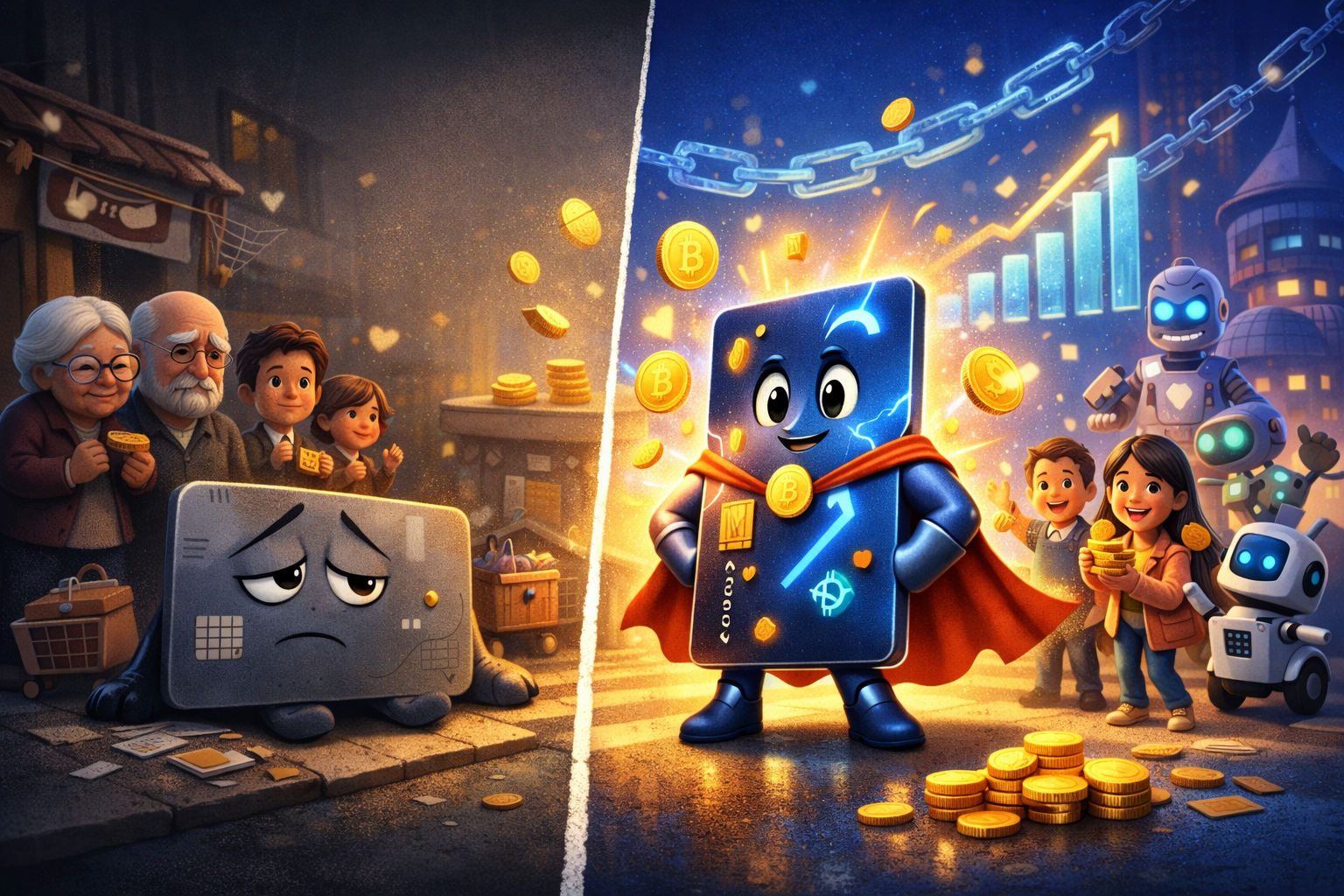
But here's the interesting bit: that might be about to change. Rather dramatically, actually.
The Rewards Pyramid Scheme Nobody Talks About 🎪
The credit card industry runs on a simple principle: the majority of customers subsidize the rewards of a privileged few.
Think of it like this: You've got a pub where regulars pay £8 for a pint, but the bloke who spends £500 a week gets his drinks at £5. Except the pub doesn't absorb the difference—they charge the regulars £9 instead. You're essentially buying drinks for someone else and calling it "fair."
Here's how it actually works: When you swipe your card, merchants pay fees (typically 2-3% of the transaction). Card companies pocket these fees, then redistribute a portion as rewards—but only to their most fancy, premium customers. Everyone else? You're just generating the revenue that funds those Business Class upgrades for the frequent flyers.
The data is rather stark: According to the Federal Reserve, lower-income households effectively transfer about $15 billion annually to higher-income households through this system. You read that correctly. It's a reverse Robin Hood situation, only nobody's wearing tights.
But wait, there's more: Trump recently floated the idea of capping credit card interest rates at 10%. The current average sits around 21%. If that cap actually happens (enormous if), the entire business model shifts overnight.
So what happens when banks can't charge usurious interest rates anymore? They'll need to find revenue elsewhere. Or, more intriguingly, someone else might step in entirely.
Enter Crypto: The Unlikely White Knight 🦸
Cryptocurrency companies are positioning themselves to fill exactly this gap, using DeFi lending and token incentives to offer something banks fundamentally can't.
Imagine your credit card didn't just give you 1% cashback—it gave you actual ownership in the payment network itself. Every time you bought something, you'd earn tokens that appreciate as more people use the system. The more you spend, the more you earn, but so does everyone else. No pyramid scheme required.
This isn't theoretical. Several crypto payment platforms are already doing this:
- They offer 3-8% rewards (compared to 1-2% from traditional cards)
- They use stablecoins to eliminate foreign transaction fees
- They provide instant settlement (no 2-3 day waiting periods)
- Some even let you earn yield on your balance through DeFi protocols
The mechanism works because there's no massive banking infrastructure to maintain, no shareholder dividends to pay, and no executive bonuses that could fund a small nation. Just code, transparency, and aligned incentives.
Here's the clever bit: evolving crypto regulations might actually accelerate this. As digital assets become more mainstream, the compliance barriers that kept crypto cards in the "too risky" category are crumbling. Suddenly, offering crypto-powered rewards isn't just possible—it's competitive.
Could this actually replace traditional credit cards? Probably not entirely. But does it create genuine competition that forces banks to improve their offering? Absolutely.
Why This Matters More Than You Think 📊
If crypto successfully disrupts credit cards, we're not just talking about better rewards—we're talking about actual mass adoption of cryptocurrency.
Consider the numbers: There are roughly 365 million credit cards in the UK alone. In the US? Over 500 million. If even 10% of those users switch to crypto-based payment systems, you've just onboarded 50-80 million people into the crypto ecosystem.
That's not enthusiasts buying Bitcoin because they read something on Reddit. That's regular folks using crypto because it saves them money and offers better rewards. That's your mum, your neighbor, and yes, even that chap buying his weekly shop at Tesco.
This is precisely how new technologies achieve mainstream adoption—not through revolution, but through solving everyday problems better than existing solutions. You don't need to understand blockchain any more than you need to understand how Visa's network operates. You just need to know it works and benefits you.
The wildcard? Regulatory clarity. Trump's interest rate cap proposal, combined with evolving crypto regulations, creates a perfect storm of opportunity. Banks suddenly need new revenue models. Crypto companies suddenly have regulatory approval. Consumers suddenly have leverage.
The timeline matters: Midterm primaries begin in March. Any controversial policies—including credit card interest caps—need to happen soon or risk political backlash. That's a very narrow window, which means decisions get made quickly.
Are you ready for that shift, or are you still thinking of crypto as just speculation?
The Uncomfortable Truth About Change
Right, so here's where we are: The credit card system has quietly redistributed wealth upward for decades, banks have profited obscenely from the arrangement, and most of us have simply accepted it because, well, what's the alternative?
Turns out, the alternative might be arriving whether banks like it or not.
It's rather like when budget airlines forced legacy carriers to compete. The old guard spent years insisting their premium service justified premium prices—until Ryanair proved you could fly to Spain for £29. The legacy carriers didn't disappear, but they certainly had to sharpen up.
My prediction: Within two years, you'll see at least three major crypto payment cards available in mainstream markets, offering rewards that make traditional cards look positively Dickensian. Banks will respond by marginally improving their offerings. Consumers will win. The question is only how quickly this unfolds.
The really interesting bit? This could be the Trojan horse that brings cryptocurrency into everyday life for millions of people who currently think Bitcoin is a scam and blockchain is something to do with construction.
Get the latest news, tips, and updates!
Enter your info below to get helpful updates about how to make money from crypto.
We hate SPAM. We will never sell your information, for any reason.
